Large Hadron Collider and Beamcrafting
The Large Hadron Collider makes particles by accelerating a beam and then colliding it with itself. A Source Chamber makes the particles and a beamline carries them into the small ring, which accelerates them as long and as hard as you tell it to, and the large ring splits the beam in two and crashes the halves together. You do not pick what comes out of the collision. Every particle whose rest mass fits under the collision energy is on the table, and each output hatch picks its own at random. How hard you push the energy decides what is even possible. The Beam Crafter then takes two of those beams as an ingredient, alongside ordinary items and fluids, and makes containment units, quark creation catalysts and boundless cosmic solder out of them.
It starts at UV and replaces the Compact Cyclotron, which is deprecated in this release and gone in 2.10.
The rings and the modules
The LHC is two overlapping rings with four modules hanging off the outer one. You do not have to build all the modules at once. It is 109 by 122 across and 13 tall, with the controller at the front centre of the accelerator ring. The small ring accelerates and the large one collides. Each module is marked with its letter on the roof; which ones you build decides what the machine can give you.
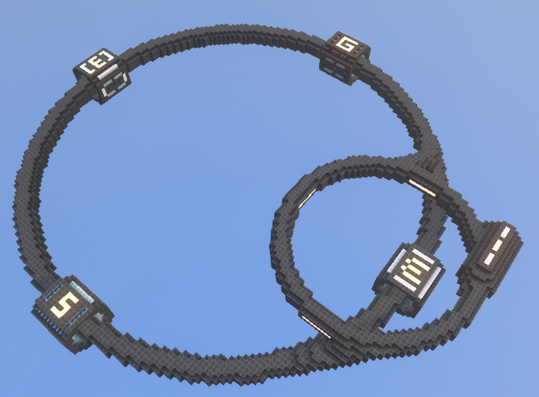
| Module | Letter | Casing | Particles it can output |
|---|---|---|---|
| Electromagnetism | E | Charged Matter Sensor (CMS) | photon, W boson, electron, muon, tau, proton, omega |
| Weak interaction | W | Advanced Total Lepton Assimilation Snare (ATLAS) | everything except the photon and the graviton |
| Strong force | S | Absolute Lattice Integrated Chromodynamic Encapsulator (ALICE) | proton, neutron, lambda, omega, eta, J/psi, upsilon |
| Gravity | G | Localized Horizon Curvature Binder (LHCb) | Higgs, graviton |
A module you leave out does not stop the structure forming. The hologram draws one more module per item in the stack you are holding, so the ring can go up first and the modules follow one at a time.
Shipped in: GT5-Unofficial #5135, GT5-Unofficial #6284, GT5-Unofficial #6151, GT5-Unofficial #6144, NewHorizonsCoreMod #1663
Accelerator mode, collider mode
The LHC runs in two modes and moves between them on its own: it accelerates the beam one cycle a second until it reaches the target energy or the cycle limit you set, then collides it. Those two numbers are the only things you set.
Each acceleration cycle turns the EU it cost into beam energy at 0.1 eV per EU, divided by the beam rate, up to a ceiling of 2 TeV. Rate is how many particles the beam carries at once, and it works like parallels: a Beam Crafter recipe wants a fixed number of particles and counts every one that arrives as progress, so twice the rate is half the time. It does nothing for the acceleration itself, where a cycle adds the same energy whatever the rate is. Energy decides what the collider can make, rate decides how fast the machine downstream gets through a recipe. Once the beam has reached the target energy the cycles keep running and raise the rate instead: 0.3 times the current rate, added to it, every second, compounding. Above a threshold that growth flattens off to the square root of what it used to add.
Power is 1A of UV per point of rate, multiplied by the square of the cycles run so far, so a late cycle costs far more than an early one for the same 30% of rate. Every cycle you add makes each particle more expensive than the last, which is what the cycle limit is for. Only charged particles accelerate; feed the ring a neutral beam and it stops with a message saying why.
In collider mode the beam is split in two, sent both ways round the large ring and collided. The collision energy is twice the beam energy, so 4 TeV at most. A particle becomes possible as soon as the collision energy passes its rest mass; the Higgs is the heaviest of them at 125.11 GeV, so past that nothing is out of reach. Each output hatch then picks its own particle at random, weighted, from the ones its module can see: the gravity module sees only two, so above 125.11 GeV it gives a graviton roughly three times in four and a Higgs the rest of the time.
Shipped in 9 pull requests
- LHC rate scaling nerf (GT5-Unofficial #6930)
- Small LHC rate scaling buff (GT5-Unofficial #7237)
- Buff LHC by pushing back power nerf threshold (GT5-Unofficial #7903)
- LHC balancing tweaks for Higgs and power cost (GT5-Unofficial #6662)
- lhc output roll fix to be per hatch. also add scan message if off (GT5-Unofficial #6593)
- LHC - fix small RNG bug for blacklisted particles (GT5-Unofficial #6726)
- LHC/stabilizer minor fixes + Quark catalyst recipe adjustment (GT5-Unofficial #6556)
- Fix LHC turning off after server restart (GT5-Unofficial #7466)
- Booster Fluids for LHC (GT5-Unofficial #8002)
The panel, the calculator and NEI
Because the LHC gives you a random particle rather than a fixed output, most of the work on its interface went into telling you what the odds actually are.
The readout lists five lines: beam energy, beam rate, power draw, cycles completed and what the machine is doing. The two numbers you set, the target beam energy and the cycle limit, are in a small panel that opens beside it.
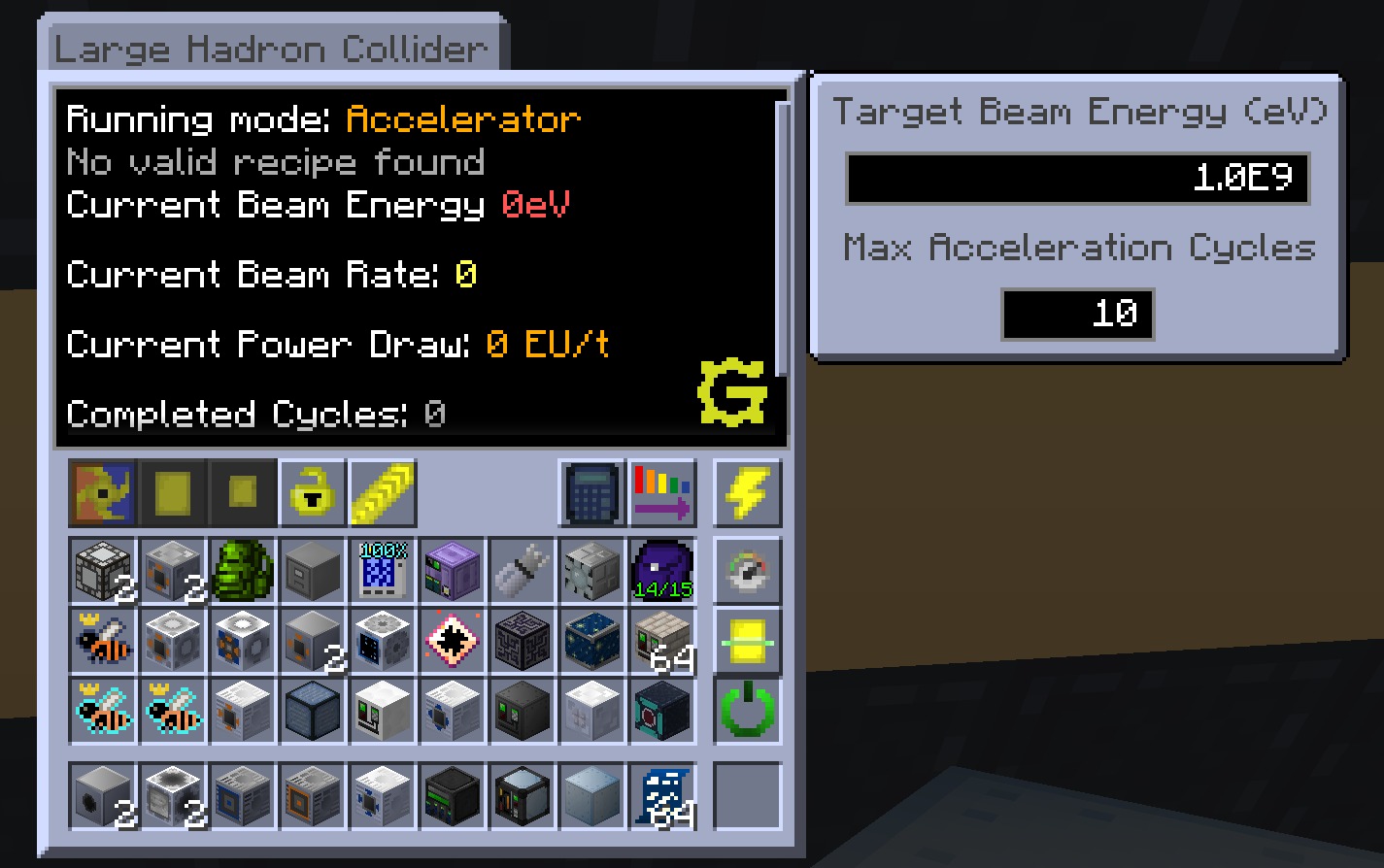
Two calculator widgets come with it. One takes an input beam energy and rate, a target energy and a cycle count, and answers with the collision energy, the rate and the power draw you would end on. The other takes a collision energy and prints the probability of every particle in every module, which is the table you want when you are deciding what to aim at.
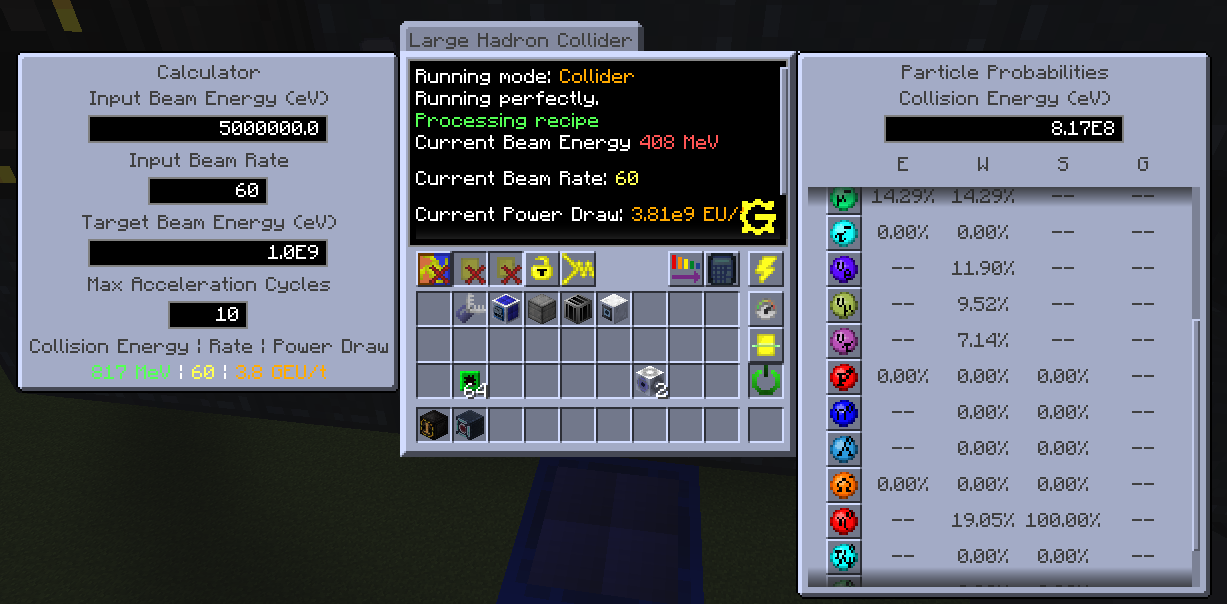
LHC recipes are in NEI. Rather than splitting the four modules into four tabs, the handler draws the progress bar of whichever module the recipe belongs to. The bar is clickable to page through the rest. There is deliberately no EU/t, no beam energy, no processing time and no probability on the outputs: none of those are fixed numbers.
Shipped in: GT5-Unofficial #6678, GT5-Unofficial #6815, GT5-Unofficial #7920, GT5-Unofficial #6828, GT5-Unofficial #6195, GT5-Unofficial #6278, GT5-Unofficial #7001, GT5-Unofficial #8030
The Beam Crafter
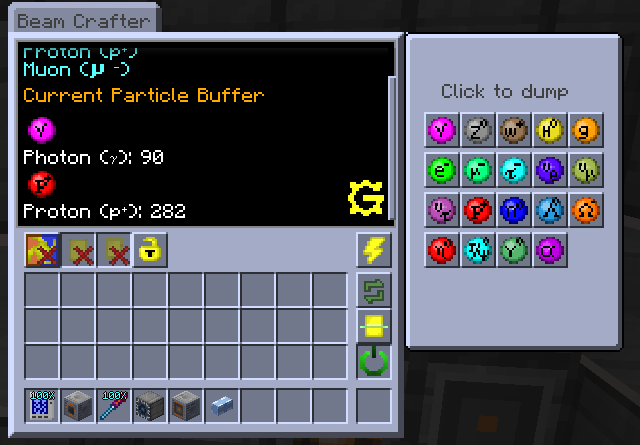
The Beam Crafter collides two particle beams into the items and fluids in its buses, buffering particles until it has enough of them to finish. It has two beam input hatches, either of which takes either beam.
Items and fluids are taken the moment a recipe starts, and the machine then waits. Arriving particles go into a buffer, up to two billion of each type, and progress is measured purely by what it pulls back out of that buffer. That is what lets it work with a source that emits in bursts. It only takes particles in while a recipe is running, though, so a beam arriving between recipes is lost. The buffer is on the screen with a button to dump it. Items, fluids and beams all scale across its 1024 parallels.
Shipped in 10 pull requests
- Beamcrafter fixes and GUI (GT5-Unofficial #6124)
- Beamcrafter logic fix (GT5-Unofficial #6185)
- Beamcrafter logic fixes (round 2) (GT5-Unofficial #6239)
- Fix Beam Crafter's recipe check for effective voltage (GT5-Unofficial #6509)
- Beamcrafter hatch priority fixes and disallow CRIBs (GT5-Unofficial #6928)
- Make MTEBeamCrafter use ProcessingLogic to support CRIB (GT5-Unofficial #7303)
- Change Beam Crafter to fix power usage for 1 tick recipe (GT5-Unofficial #7308)
- fix beam crafter tooltip (GT5-Unofficial #7736)
- move beamcrafter controller recipe to scanner (GT5-Unofficial #7691)
- Beam Crafter - Allow particle buffering with no active recipe (GT5-Unofficial #8303)
Mirrors, splitters and stabilizers
Three small multiblocks carry beams from the machines that make them to the machines that use them: a mirror that turns a beam a corner, a splitter that sorts one beam into several, and a stabilizer that smooths a bursty source into a steady feed.
The Beam Mirror takes a beam in and sends it back out. It has two forced structures: tier 1 bends the beam 90 degrees, tier 2 sends it back 180.
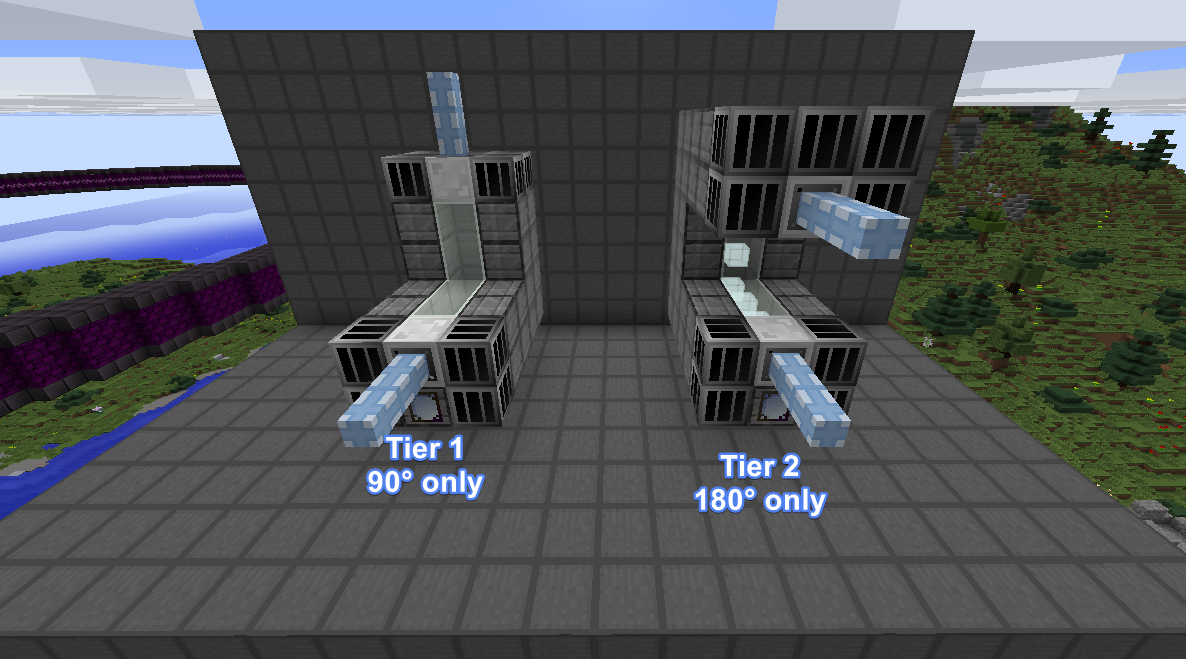
The Beam Splitter divides an incoming beam evenly among its output hatches. Each hatch blacklists the particles it does not want, so one beam carrying a mix comes out sorted.
The Beam Stabilizer sits between a source that fires in bursts and a machine that wants a steady feed. It holds up to 100000 particles and re-emits them at a rate you choose, which it remembers. A packet with a different particle, energy or focus is ignored while it still has something stored and accepted once it runs dry.
Shipped in: GT5-Unofficial #6866, GT5-Unofficial #7051
Beamcrafting recipes and the Compact Cyclotron
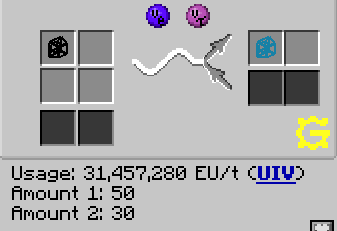
The Beam Crafter has 22 recipes: containment units, quark creation catalysts, the LHC's own module casings and the lens for a Quantum Anomaly.
Four of the recipes are the module casings, so the machine is partly its own prerequisite: build the ring and one module, and that module pays for the next three. Another four are the containment units: stable baryon, lepton, meson and boson. Those are where the LHC joins the rest of the progression, because recipes that used to take raw particle items from the Compact Cyclotron take a containment unit now. Then six quark creation catalysts, one per flavour up to top; neptunium-238 and deep earth reactor fuel; an energized tesseract at UIV; excited plutonium fuel at ZPM; and transcendent metal nanites alongside boundless cosmic solder.
The Compact Cyclotron is deprecated: its controller can no longer be crafted and its tooltip says DEPRECATED in red. Its recipes still work for the whole of 2.9 and come out in 2.10, so a cyclotron you have already built keeps running until then. The DTPF recipe that turned gravitons into a Quantum Anomaly now takes the beamcrafted item. The Quantum Anomaly got a beamcrafting recipe of its own as well, because the cyclotron-era one does not scale once you have an LHC feeding it.
check your build - GT5-Unofficial #6166. The steps are on the Before you update page.
Shipped in: NewHorizonsCoreMod #1498, GT5-Unofficial #6166, NewHorizonsCoreMod #1661, NewHorizonsCoreMod #1817, NewHorizonsCoreMod #1715, GT5-Unofficial #8017
Source Chamber, LINAC and the beamline
The LHC does not make its own particles: a Source Chamber makes them and a beamline carries them into the ring through an ordinary beam input hatch. A LINAC in between gives the beam a head start, but it is not required; the ring accelerates from whatever energy it is handed. Anything the LHC sends back out travels the same way.
Two beamline recipes changed: molten metal comes out in whole ingot amounts now, and raw advanced crystal chips can be made on a beamline out of CeLuAG.
Shipped in: GT5-Unofficial #5038, GT5-Unofficial #5513, GT5-Unofficial #7994, GT5-Unofficial #8139, GT5-Unofficial #8308
The Target Chamber
A Target Chamber craft stops making progress when the beam stops matching it, and picks up where it left off when the beam comes back. Energy, focus, particle and rate are all checked while it runs, not only when the recipe starts. Its NEI page no longer repeats the voltage line.
Engraved lapotron chips can be made in it straight from a beam, with no LHC needed.
Shipped in: GT5-Unofficial #7774, GT5-Unofficial #7753, GT5-Unofficial #7591, GT5-Unofficial #7590, GT5-Unofficial #6682, GT5-Unofficial #8099
Contributors
Everyone who authored, reviewed or co-authored a change on this page, with how many of them:
@ham-corp (34), @Dream-Master (22), @UltraProdigy (11), @Ruling-0 (9), @AnsonYeung (6), @chrombread (6), @Nana-Sakura (5), @boubou19 (4), @Auynonymous (3), @DylanTaylor1 (2), @Eldrinn-Elantey (2), @fehling135 (2), @Luca-Guettinger (2), @Sanduhr32 (2), @Worive (2), @ABKQPO (1), @Alexdoru (1), @Angry3vilbot (1), @Azusfin (1), @cubefury (1), @czqwq (1), @DreamYao520 (1), @EnderProyects (1), @error1number404 (1), @FourIsTheNumber (1), @FrostyFire1 (1), @glowredman (1), @Guvante (1), @koolkrafter5 (1), @lonei-G (1), @Miklebe (1), @NotAPenguin0 (1), @OTPANNIEXD (1), @Ranzuu (1), @slprime (1), @TheYoingLad (1), @Yoshy2002 (1)